In short
- On the 1981 to 2010 normals, Ottawa gets roughly 175 cm of snow in a year and keeps 20 cm or more on the ground for about 40 days.
- One Ontario firm cites a code minimum of 1.5 kPa (about 31 lb per sq ft) for flat roofs and says 2 to 3 feet of wet snow can weigh 40 to 60 lb per sq ft.
- A Canada-wide guide gives snow load requirements from 30 to 80 lb per sq ft, depending on the region.
- Single-family and multi-family housing account for the most critical injuries and fatalities from falls in Ontario construction, per the provincial ministry of labour.
- Roofers in Ottawa charge $50–$100 an hour on HomeStars; no source we opened prints a roof snow removal price.
How much snow Ottawa gets
Current Results, working from Environment Canada’s 1981 to 2010 normals, puts a year’s snowfall in Ottawa near 175 cm. Snow of at least 1 cm lies on the ground for around 115 days, and 20 cm or more for around 40 days, mostly from January to March. Storms of 10 cm or more in a day come three or four times a year. A roof carries that snow for months, and a thaw or a rain turns it into a heavier, wetter layer.
What load a roof is built for
Roofs are designed for a snow load. One Ontario firm states that the code requires flat roofs to carry at least 1.5 kPa, about 31 lb per sq ft, and says 2 to 3 feet of wet snow on a flat roof can weigh 40 to 60 lb per sq ft. A Canada-wide guide lists snow load requirements from 30 to 80 lb per sq ft by region. We found no single Ottawa figure on a page we could open, so the design value for your house belongs to the building code and the people who read your framing.
That reading depends on age. Older roofs may have undersized joists, past water damage or changes made later: an addition, a dormer, a second layer of shingles. The Ontario firm notes that older buildings with undersized joists sometimes need reinforcement. A roofer who has opened the roof sees more than a number does.
Drifts, valleys and flat sections
Load is rarely even. Snow drifts against walls, collects in valleys and piles behind chimneys. A lower roof beside a taller wall takes the drift. Flat roofs hold water as well as snow, and ponding adds weight. The flat roof page and the flat roof cost guide explain drainage. On a sloped roof the lower edge holds the ice, which links to ice dams.
Why clearing belongs to a trained crew
Roof work is work at height. Ontario’s labour ministry finds that houses, single and multi-family, produce by far the most critical fall injuries and deaths in construction, and ran a campaign of 6,978 field visits in 2024 and 2025 focused on residential fall protection. Certain workers on construction projects must hold working at heights training approved by the Chief Prevention Officer. Snow and ice add to the hazard.
The roof surface needs care too. Ask the company how it protects shingles, membranes and skylights and what its liability cover includes. The Insurance Bureau of Canada lists snow management among the main ways to limit ice dams.
What to do while you wait
Stay off the roof. Keep people, cars and paths clear of the eaves below, because snow and ice can slide. Move belongings away from any ceiling that is stained or bulging. Water entering the house turns it into an emergency roof repair call, so put that first in the request. If you hear or see new cracks inside, leave that room and tell the company on the phone.
After the snow goes
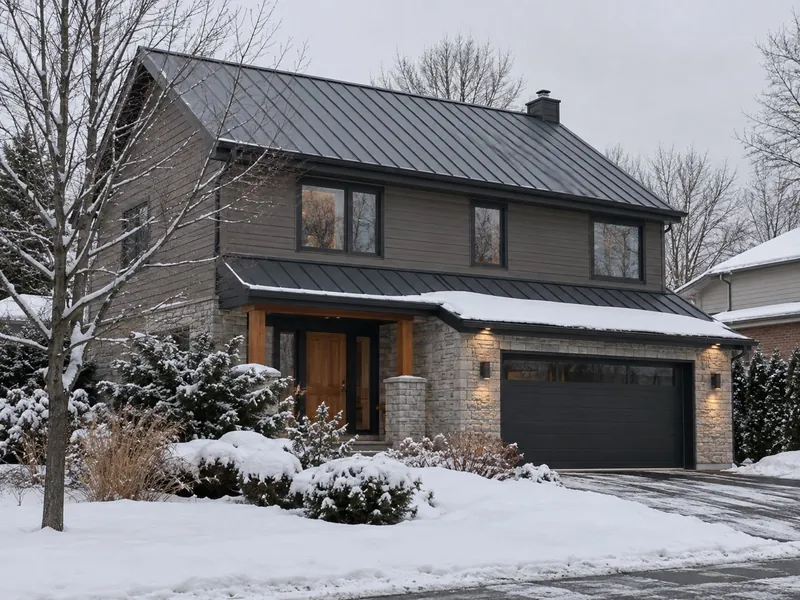
When the roof is clear, look at what winter did. The roof check after winter page lists the spring visit, and a roof inspection puts the findings in a report. Metal roofs carry their own risk of sliding ice.
Who you are dealing with
The independent company we forward this to decides whether it clears snow, repairs the roof or both, and quotes the visit. Ask how its crew works at height and keep the answers in writing.
Questions to ask the company
- Do you clear snow from roofs, and with what method: hand tools, a long-handled tool, or a crew on the roof?
- What fall protection does your crew use, and do they hold working at heights training?
- How do you protect shingles, membranes and skylights while clearing?
- Do you charge by the hour or by the roof, and is there a minimum?
- Can you check the attic and the eaves at the same visit?
Have this ready for the call
- Roof type and age: shingles, metal, flat membrane
- Approximate snow depth in several spots, from photos taken from the ground
- What you see inside: new cracks, doors that stick, sagging, or water stains
- Where the snow sits: over an addition, a porch, a valley, against a wall
- Whether a car, a path or a neighbour's yard is below the eave
Questions people ask
How much snow can my roof hold?
It depends on how the roof was built. One Ontario firm cites a code minimum of 1.5 kPa, about 31 lb per sq ft, for flat roofs, and a Canada-wide guide lists requirements between 30 and 80 lb per sq ft by region. Ask the company about your framing, age and past repairs.
Is wet snow heavier than powder?
Yes. The same depth weighs more when it is wet, and rain on top adds to the load. The Ontario firm puts 2 to 3 feet of wet snow on a flat roof at 40 to 60 lb per sq ft. A thaw followed by a freeze turns snow to ice, which is heavier again, so the weight changes through the winter.
Does clearing snow prevent ice dams?
It reduces the melt that feeds them. The Insurance Bureau of Canada lists snow management with insulation and ventilation as the three factors. The cause sits in the attic, so a company that clears snow should also check the heat loss that melts it from below.
Who pays if clearing damages my roof?
That depends on the contract and your insurance. Ask the company what its liability cover includes and get the answer in writing before the visit. Your own policy wording on damage from removal work is worth reading as well, and so is any contract the company hands you.
What if the snow slides off onto a walkway or a car?
It can. CAA-Quebec says big plates of ice may let go from a metal roof all at once, and falling ice is a hazard for anyone walking below. Keep people and vehicles clear of the eave below until a company has looked at the roof, and say in the request what sits below it.
Why do roofers want an attic look at the same visit?
Snow that melts unevenly points to heat escaping into the attic. CAA-Quebec names poor ventilation and heat loss as the main cause of ice at the roof edge. A company that sees both the snow and the attic can separate a weather problem from a building problem.